

I still remember the moment I realized my laptop could be my passport to the world. While scrolling through social media, I saw a friend coding from a beach in Bali—her office was a hammock, her commute a stroll through rice fields. That’s when it hit me: What if I didn’t have to choose between my career and my curiosity?
Specialized programs now let professionals like us live abroad while earning income online. These aren’t tourist passes—they’re designed for location-independent workers who want stability without sacrificing adventure. I’ve spent months researching destinations that balance reliable internet with cultural richness, and I’m excited to share what I’ve learned.
The freedom to wake up in Lisbon one month and Costa Rica the next isn’t just possible—it’s increasingly accessible. From tax benefits to community networks, governments worldwide are competing to attract skilled remote professionals. Let’s explore how you can turn this global shift into your personal opportunity.
Key Takeaways
- Digital nomad visas provide legal authorization to work remotely from foreign destinations
- Program durations typically range from 6 months to 2 years
- Income requirements vary significantly between locations
- Many destinations offer tax incentives for remote workers
- Strong Wi-Fi and expat communities are key selection factors
- Application processes often require proof of employment and savings
Introduction: Why Remote Work Visas Matter
The moment I realized my income wasn’t tied to a zip code sparked a revolution in my lifestyle. Traditional office setups began feeling restrictive as I watched colleagues thrive from mountain towns and coastal villages. Technology erased geographic barriers, but legal frameworks hadn’t caught up—until now.
Specialized visa programs solve a critical puzzle: how to live freely while maintaining compliance. During my first year abroad, I learned the hard way that tourist stamps don’t cover professional activities. These permits provide legitimacy, letting workers contribute to local economies without overstaying welcome.
Governments recognize the value of attracting skilled professionals. One official told me, “Remote workers stay longer and spend deeper than vacationers.” This symbiotic relationship fuels infrastructure improvements and cultural exchanges. My favorite café in Lisbon? Founded by a programmer-turned-barista who came on a digital nomad visa.
| Aspect | Traditional Tourist Stay | Remote Work Visa |
|---|---|---|
| Legal Work Status | Prohibited | Explicitly Allowed |
| Duration | 30-90 Days | 6-24 Months |
| Bank Requirements | None | $2,000-$5,000/month |
Beyond paperwork, these programs create stability. I no longer panic about border runs or unexpected policy changes. Instead, I focus on building routines between exploring—knowing my living situation is secure. For destinations, it’s a win-win: fresh perspectives meet sustainable tourism growth.
Understanding Digital Nomad and Remote Work Visas
My first border crossing with a laptop taught me an uncomfortable truth: most entry stamps don’t cover professional activities. That’s where specialized digital nomad visas change everything—they’re golden tickets for location-independent careers.

What Is a Digital Nomad Visa?
Think of it as a hybrid between a tourist pass and a residency permit. These programs grant temporary legal status—usually 12 months—to individuals earning income abroad. Unlike standard tourist arrangements, you’re explicitly allowed to work for clients or employers outside your host nation.
During my application process, I discovered most programs require proof of income (typically $2,000-$5,000/month). One immigration officer explained: “We want nomads who contribute without draining resources.” Renewals often extend stays to 2+ years, perfect for serial explorers.
How They Differ from Tourist Visas
Standard vacation permits come with hidden limitations. You can’t legally send emails for your job or invoice clients—technically, that’s employment. Digital nomad visas erase this gray area. They also unlock practical benefits:
| Feature | Tourist Visa | Nomad Visa |
|---|---|---|
| Work Authorization | No | Yes |
| Typical Duration | 30-90 Days | 12-24 Months |
| Local Bank Access | Rare | Common |
Last year in Croatia, my nomad visa let me rent an apartment long-term and join coworking spaces. Tourist visitors? They’re still hunting for reliable Wi-Fi between Airbnb hops. These programs create stability—you’re not just passing through, but temporarily belonging.
Remember: these aren’t immigration pathways. They’re designed for mobile professionals who want roots without permanence. As my Portuguese lawyer friend says, “It’s about thriving abroad, not just surviving.”
Key Benefits for Digital Nomads and Remote Workers
Securing proper documentation transformed my nomadic experience from anxious to authentic. No more counting calendar days or hiding my laptop at border crossings. These specialized permits let me focus on what matters: building connections and refining my craft.
Stability Breeds Productivity
My Croatian residency card arrived three weeks after applying. Suddenly, I could sign annual apartment leases and register for national healthcare. Legal clarity changed everything – no more “visa run” anxiety before client meetings. Extended stays (up to 24 months!) let me:
- Develop local language skills
- Build trust with neighborhood vendors
- Establish morning routines between exploration
Unexpected Perks Beyond Savings
Portugal’s non-habitual resident tax regime surprised me. Qualified professionals pay flat 20% income tax for a decade. Combined with Lisbon’s affordable markets, my savings rate doubled. But the real value came from:
| Service | Tourist Access | Nomad Access |
|---|---|---|
| Co-working discounts | None | Up to 40% off |
| Local SIM cards | Prepaid only | 12-month contracts |
| Bank loans | Unavailable | Possible after 6 months |
Last month, I collaborated with a Brazilian designer met through Porto’s official digital nomad Slack group. These programs don’t just open doors – they build bridges between global minds.
Top countries that offer remote work visas
Three years ago, tracking down legitimate residency options felt like hunting unicorns. Today, 58 nations welcome mobile professionals through specialized programs—a 176% increase since 2021. This explosion reflects a fundamental shift in how governments view temporary residents.

Caribbean nations often lead with tax incentives and tropical perks. European programs emphasize cultural access and Schengen zone mobility. Asian destinations attract with affordability and emerging tech hubs. Each region tailors its approach:
| Region | Example Nations | Key Benefits | Income Requirements |
|---|---|---|---|
| Caribbean | Barbados, Antigua | 12-month stays, no local taxes | $50,000/year |
| Europe | Portugal, Croatia | Healthcare access, EU travel | $3,300/month |
| Asia | Malaysia, Indonesia | Low cost of living, coworking networks | $24,000/year |
I’ve watched programs mature from shaky pilot projects to polished systems. Many now process applications in under 30 days—a far cry from the 6-month waits of 2020. Renewal options let established nomads extend stays up to five years in some cases.
What excites me most? The creative solutions emerging. Georgia offers 1-year permits for content creators earning $2,000/month. Argentina prioritizes Spanish learners with discounted visa fees. These innovations help professionals align their lifestyle with career goals.
Choosing your basecamp becomes an exercise in self-discovery. Do sunrise surf sessions fuel your creativity? Or do medieval cobblestone streets spark better ideas? The current landscape supports both—and countless hybrid possibilities.
Costa Rica: Embracing Nature and Remote Work
Waking up to howler monkeys and brewing coffee while overlooking misty volcanoes convinced me Costa Rica understands work-life harmony. This biodiverse haven offers more than postcard views—it provides a structured path for location-independent professionals through its Digital Nomad Visa program. Let me break down why this Central American gem tops my recommendation list.
The Remote Workers and Service Providers permit grants two full years of legal residency. You’ll start with an initial 12-month visa, renewable for another year—a rarity among short-term programs. What sealed the deal for me? Zero local taxes on foreign-earned income. My design clients in Chicago pay the same rates, but my cost of living dropped 40%.
| Requirement | Details |
|---|---|
| Monthly Earnings | $3,000+ (proof required) |
| Employment Terms | Exclusively non-Costa Rican entities |
| Health Coverage | International or local insurance |
| Duration | 1+1 year extension |
Local communities welcome nomads who respect their eco-conscious values. I’ve attended beach cleanups with fellow remote workers and traded coding skills for surf lessons. The health insurance rule ensures everyone contributes fairly—I chose a $75/month local plan covering emergencies and dental.
Costa Rica’s magic lies in its ability to sharpen focus. Mornings start with waterfall hikes before tackling client projects. Afternoons might involve brainstorming sessions with toucans as background vocalists. This isn’t just a visa—it’s an invitation to rewrite your definition of productivity.
Estonia: Pioneer in Digital Nomad Visas
Opening my Estonian e-residency kit felt like receiving a golden ticket to the future. The sleek card holder contained more than government paperwork—it symbolized access to Europe’s most advanced digital society. This tiny Baltic nation didn’t just create the world’s first digital nomad visa in 2020—it redefined what remote professionals can achieve abroad.
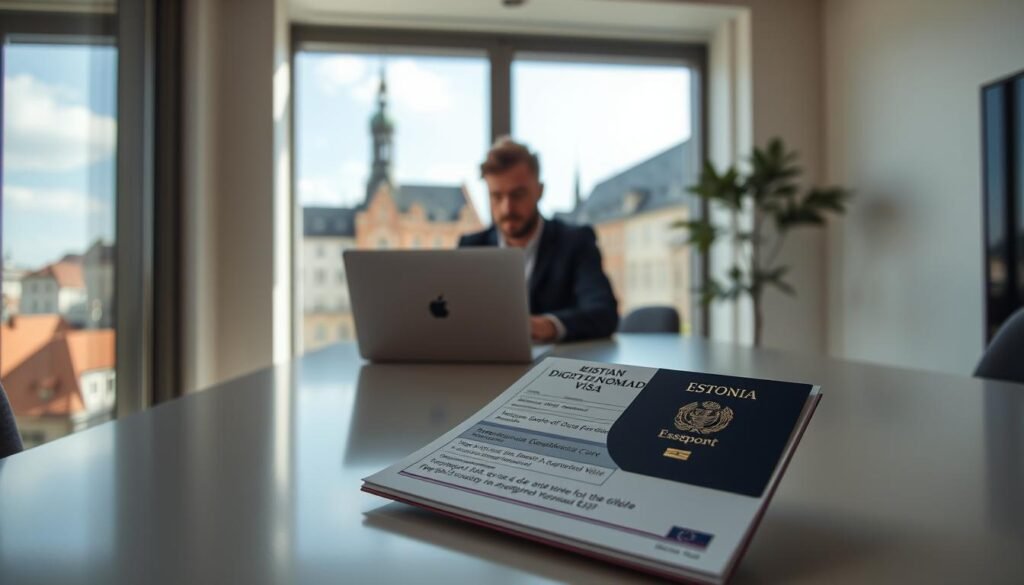
Estonia’s forward-thinking approach starts with its revolutionary e-residency program. Over 100,000 global entrepreneurs use this system to manage EU-based businesses digitally. When they launched the nomad visa, it felt like a natural extension of their tech-first philosophy. “We’re building a borderless digital nation,” explained a Tallinn-based startup founder I met at a co-working space.
Blueprint for Tech-Driven Residency
The application process reflects Estonia’s efficiency. You’ll need:
| Requirement | Details |
|---|---|
| Employment Proof | Contract with non-Estonian company or freelance clients abroad |
| Monthly Income | €4,500 sustained for 6 consecutive months |
| Work Capacity | Fully remote using digital tools |
What surprised me most? How medieval architecture coexists with cutting-edge infrastructure. I’ve filed taxes from a 15th-century café with faster Wi-Fi than my Brooklyn apartment. The 1-year permit lets you experience seasons—crisp autumn walks through Tallinn’s Old Town followed by midsummer nights under the midnight sun.
While the income threshold seems high, it ensures participants contribute meaningfully. My favorite perk? Access to digital services usually reserved for citizens. I now sign documents with secure e-signatures and vote in some business decisions through Estonia’s digital governance platform.
This program isn’t just about living abroad—it’s about future-proofing your career. As I update my clients from a solar-powered workspace in Tartu, I realize Estonia isn’t chasing trends. They’re writing the playbook for 21st-century global professionals.
Spain: Blend of Culture and Remote Opportunities
Sunlight filtering through Gaudí’s stained glass windows taught me creativity thrives in Barcelona’s rhythm. Spain’s digital nomad visa unlocks more than tapas trails—it merges historic charm with modern professional infrastructure. Mediterranean breezes carry inspiration here, whether you’re drafting proposals near Roman aqueducts or debugging code on Ibiza’s shores.
Unique Eligibility Criteria and Visa Benefits
Spain sets clear requirements for global professionals. Applicants must prove monthly income of €2,400+ (€2,880 with dependents). Unlike many programs, this visa transitions to residency after 5 years—a rare pathway to EU citizenship.
| Key Advantage | Impact |
|---|---|
| Flat 24% Tax Rate | Save 10-15% vs. other EU destinations |
| Family Inclusion | Spouses/children join under single application |
| Healthcare Access | Public system enrollment after 90 days |
I secured my permit in 22 days using Spain’s streamlined online portal. Local coworking hubs like Utopicus offer discounted memberships for visa holders. Mornings now start with client calls from Valencia’s City of Arts and Sciences complex—proof that ancient alleyways and fiber-optic speeds coexist beautifully here.
This program rewards those who embrace Spain’s pace. After submitting my last income statement, I celebrated with sunset paella beside the Alhambra. Spain doesn’t just host work—it reshapes how you define professional fulfillment.
